
Skip to content

Invoices

The Invoices page shows your billing invoices and statement history for your ShipEdge account. Use this view to review charges, check final balances, and open detailed invoice lines for reconciliation and accounting.
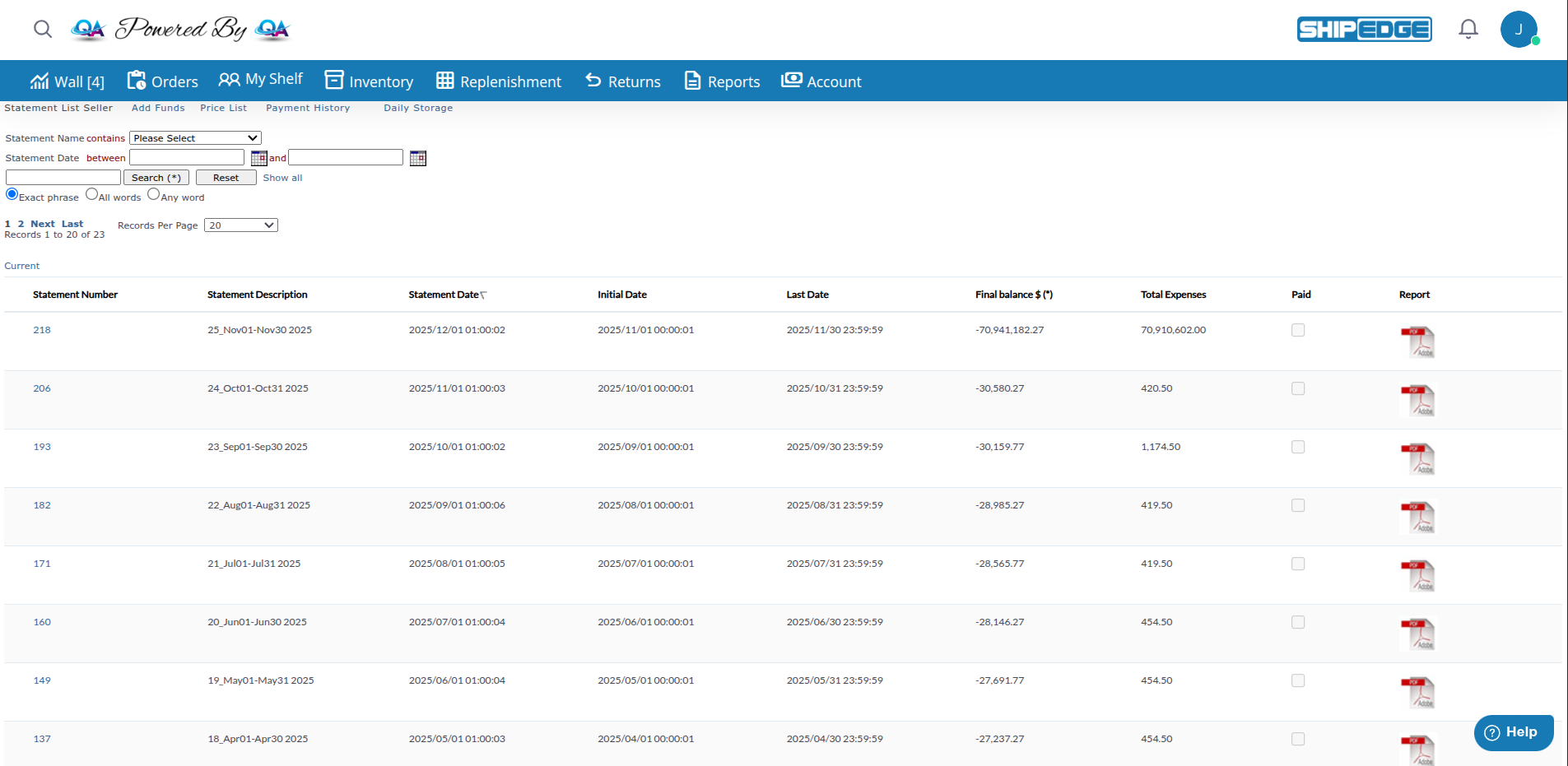
Invoices

Billing History in One Place

See all your billing invoices and statement periods in a single table. Each row represents an invoice with dates, totals, and payment status.

Understand Final Balance

Review the Final balance $ (*) column to understand how much you owe or have been charged for each invoice period.

Drill Into Details

Open the Statement Detail Seller view to see line‑level charges by service type, quantity, and description for a specific invoice.

Support Accounting & Reconciliation

Use invoice and detail exports to support reconciliation with your accounting system and internal financial reports.

  1. Open My Account

    Click My Account in the main navigation menu. This opens the Account Overview page with account-related shortcuts.

  2. Go to Invoices

    Click the Invoices option on the Account Overview page. This opens the Statement List Seller view .


The main Invoices page is labeled Statement List Seller and shows one row per invoice.

At the top of the page, you’ll find several quick access links:

  • Add Funds: Opens the Add Funds page in a new tab
  • Price List: Opens the current price list in a new tab
  • Payment History: Opens your payment history
  • Daily Storage: Opens the daily storage report in a new tab
  • Current: Opens the current invoice details filtered to show only the current invoice period

At the top of the page, you can refine which invoices are shown:

  • Statement Name:

    • Drop‑down filter labeled Statement Name
    • Uses the contains operator with a list of available invoice descriptions
  • Statement Date:

    • Uses a between range with two fields:
      • (start)
      • (end)
    • Each field has a calendar icon (Pick a Date) and includes time:
      • Start format: yyyy/mm/dd 00:01:01
      • End format: yyyy/mm/dd 23:59:59
  • Basic Search:

    • Text box with Search (*) button
    • Reset button to clear the form
    • Show all link to remove all filters
    • Search type options:
      • Exact phrase
      • All words
      • Any word

These tools let you quickly find a specific invoice by name, date range, or free‑text search.

The main table shows your invoices with sortable columns:

  • Statement Number:

    • Internal ID of the invoice
    • Clickable link that opens Statement Detail Seller for that invoice
  • Statement Description:

    • Backed by the InvoiceName field
    • Often describes the invoice period or type
  • Statement Date:

    • Date when the invoice was generated
    • Column header: Statement Date
  • Initial Date:

    • First date included in the invoice period
  • Last Date:

    • Last date included in the invoice period
  • Final balance $ (*):

    • Shows the final amount for the invoice in USD
    • Represents the total charges for that period
  • Total Expenses:

    • Shows the total expenses and subtractions (debits) associated with the invoice
  • Paid:

    • Indicates whether the invoice is marked as paid
    • Backed by a boolean field (Y / N)
    • Displayed as a checkbox (checked for paid, unchecked for unpaid)
  • Report:

    • Displays a clickable link to the PDF invoice report
    • Opens pdf_invoice2.php with the invoice ID parameter
    • Footer row shows a Count: summary of total reports

You can click column headers to sort by that field (e.g., Statement Date, Final balance $, Paid).

Below the filters, the page includes pagination controls:

  • Links: First, Previous, page numbers, Next, Last
  • Records Per Page drop‑down:
    • Options: 10, 20, 50, 100, 200, 500, All Records

Use these controls to navigate through long billing histories.


To see line‑level charges for an invoice, open the Statement Detail Seller view.

  1. Open an Invoice Detail

    From Statement List Seller, use one of these methods:

    • Click the Statement Number link in the first column
  2. Filter by Date

    At the top of Statement Detail Seller, use the Date filter:

    • Filter labeled Date
    • Uses a between range with start and end date‑time fields
    • Each field has a calendar icon with formats:
      • Start: yyyy/mm/dd 00:01:01
      • End: yyyy/mm/dd 23:59:59
  3. Filter by Service Type

    Use the Service Type drop‑down:

    • Filter labeled Service Type
    • Operator =
    • List of available service types
  4. Use Search and Reset

    In the search bar:

    • Enter keywords and click Search (*)
    • Click Reset or Show all to clear filters
    • Choose search type: Exact phrase, All words, or Any word
  5. Review Totals and Pagination

    A summary section uses the current filters to show total value for the invoice details. Pagination and Records Per Page behave like the main Invoices page.
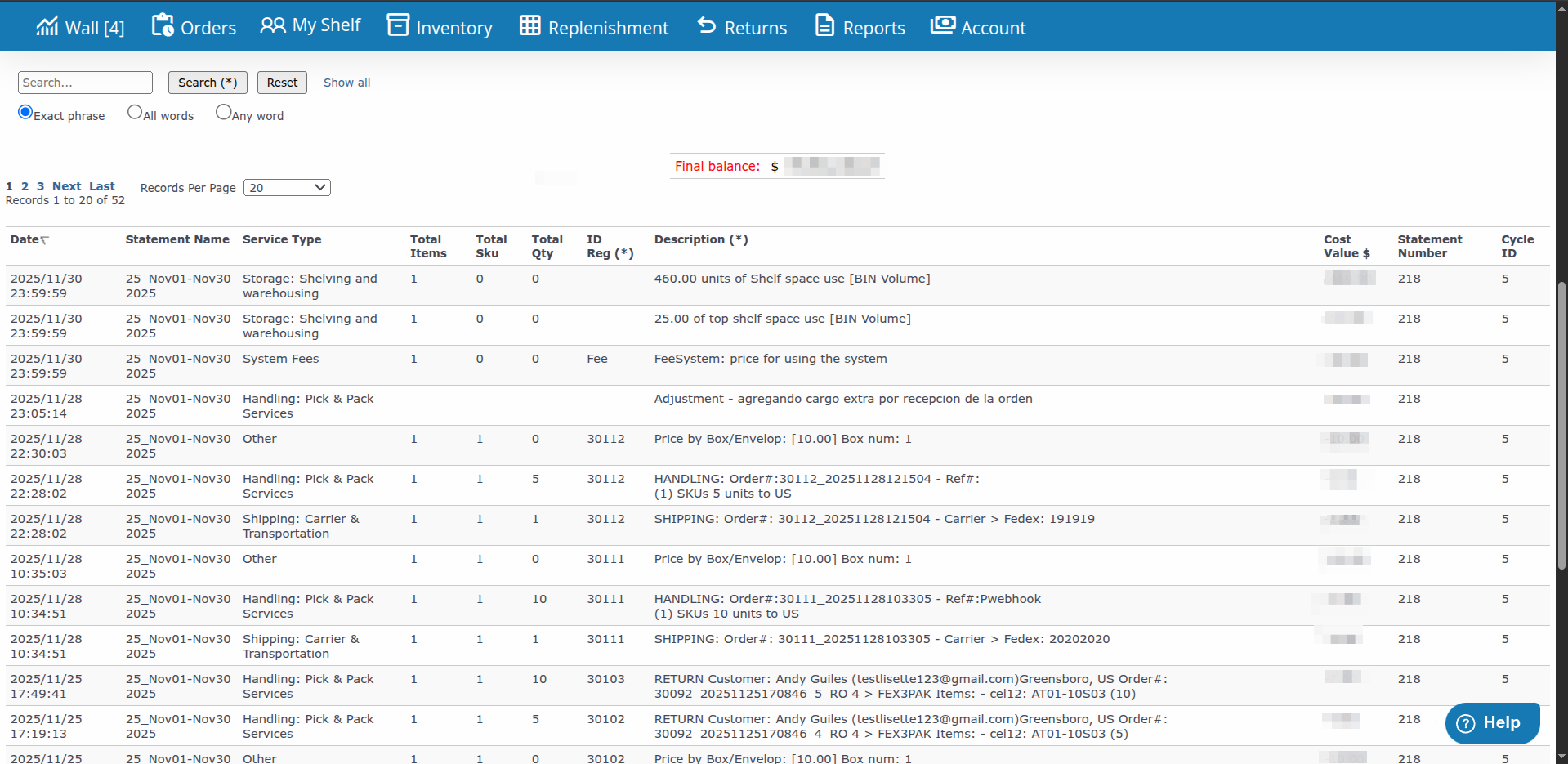
Statement Detail Seller

The Statement Detail Seller table uses a fixed set of columns:

  • Date:

    • Backed by RegisterDate
  • Statement Name:

    • Shows the statement name associated with each line
  • Service Type:

    • Type of service (e.g., storage, pick & pack, shipping service type)
  • Total Items:

    • Number of items included in that line
  • Total Sku:

    • Number of SKUs included
  • Total Qty:

    • Total quantity for the line
  • ID Reg (*):

    • Internal reference ID for the line
  • Description (*):

    • Text description of the charge or service
  • Cost Value $:

    • Monetary value of the line in USD
  • Statement Number:

    • Statement ID this line belongs to
  • Cycle ID:

    • Internal cycle identifier for the statement

At the top of the Statement Detail Seller page:

  • Link: Export to CSV

Use this export for reconciliation and importing into your accounting system.


Filter by Statement Date

Always set a clear Statement Date range when reviewing invoices. This helps you focus on the correct billing period and reduces noise.

Review Total Expenses

Check the Total Expenses column to understand total expenses and subtractions (debits) for each invoice period.

Use Invoice Detail for Disputes

When you have a billing question or dispute, open Statement Detail Seller to review the exact lines and Description (*) values before contacting support.

Export CSV for Accounting

Use Export to CSV from the detail view to load invoice lines into your accounting or BI tools for deeper analysis.

Check Paid Status

Use the Paid column on the main Invoices page to quickly see which invoices are still open and which have already been paid.

Control Access via Permissions

Limit access to Invoices to users who need billing visibility. Use the Statements permission in User Accounts under Preferences.


Invoices Option Not Visible

  • The Invoices option is controlled by user permissions.
  • Ask an account owner to verify your **Invoices ** permission in User Accounts under Preferences.

Export to CSV Not Working

  • Confirm that there are records in Statement Detail Seller for the selected filters.
  • Check your browser’s download settings or pop‑up blockers.
  • Try again with a smaller date range if the export is timing out.

Amounts Look Incorrect

  • Open Statement Detail Seller and review each line’s Service Type, Description, and Cost Value $.
  • Check whether you are filtering by the correct Date range or Service Type.
  • Review the Total Expenses column to see if subtractions (debits) are affecting the totals.
  • Compare with related views like All Transactions or Payment History if needed.

Account & Billing:

Support & Disputes:

  • Disputes – Open and track billing disputes related to invoice charges.